


Table of Contents
Immigration clients don't wait. They have deadlines: a denied petition, an expiring visa, a family separated across borders.
These are urgent, often emotional cases that need quick legal attention. PPC for immigration lawyers puts your firm at the top of Google for those timely searches.
That's the appeal, but it's also the risk. Since you pay for every click, you need to make sure your ad only surfaces for qualified prospects.
This guide walks you through the full setup on how to build an immigration PPC campaign that captures qualified inquiries. We won't settle for "more traffic.” The goal here is to attract signed cases at a lower cost with PPC. Let's dive in.
Key Takeaways
- Match your case types, language, and geography to what you can serve, and treat intake capacity as part of that equation. Our immigration law data can inform your background research before you set the campaign scope. A lead that can't be handled in the right language, in the right place, or fast enough isn't a qualified lead.
- Your targeting should follow your authorized scope and real capacity (not your zip code or the language your ads happen to run in). Federal immigration authorization can extend well beyond your office's state.
- Follow the nine-step build in order, and treat industry-wide PPC benchmarks as a starting reference point. Build your budget from your actual click-to-inquiry, inquiry-to-qualified-lead, and qualified-lead-to-signed-client rates instead.
- Set your targeting and ad policies around Google's sensitive-service restrictions, and measure success through retained clients and signed-client cost.
What Is PPC for Immigration Lawyers? When Is It Worth It?
Pay-per-click (PPC) for immigration lawyers charges you each time someone clicks your ad, and in exchange, your firm shows up for phrases like "green card lawyer" or "H-1B attorney."
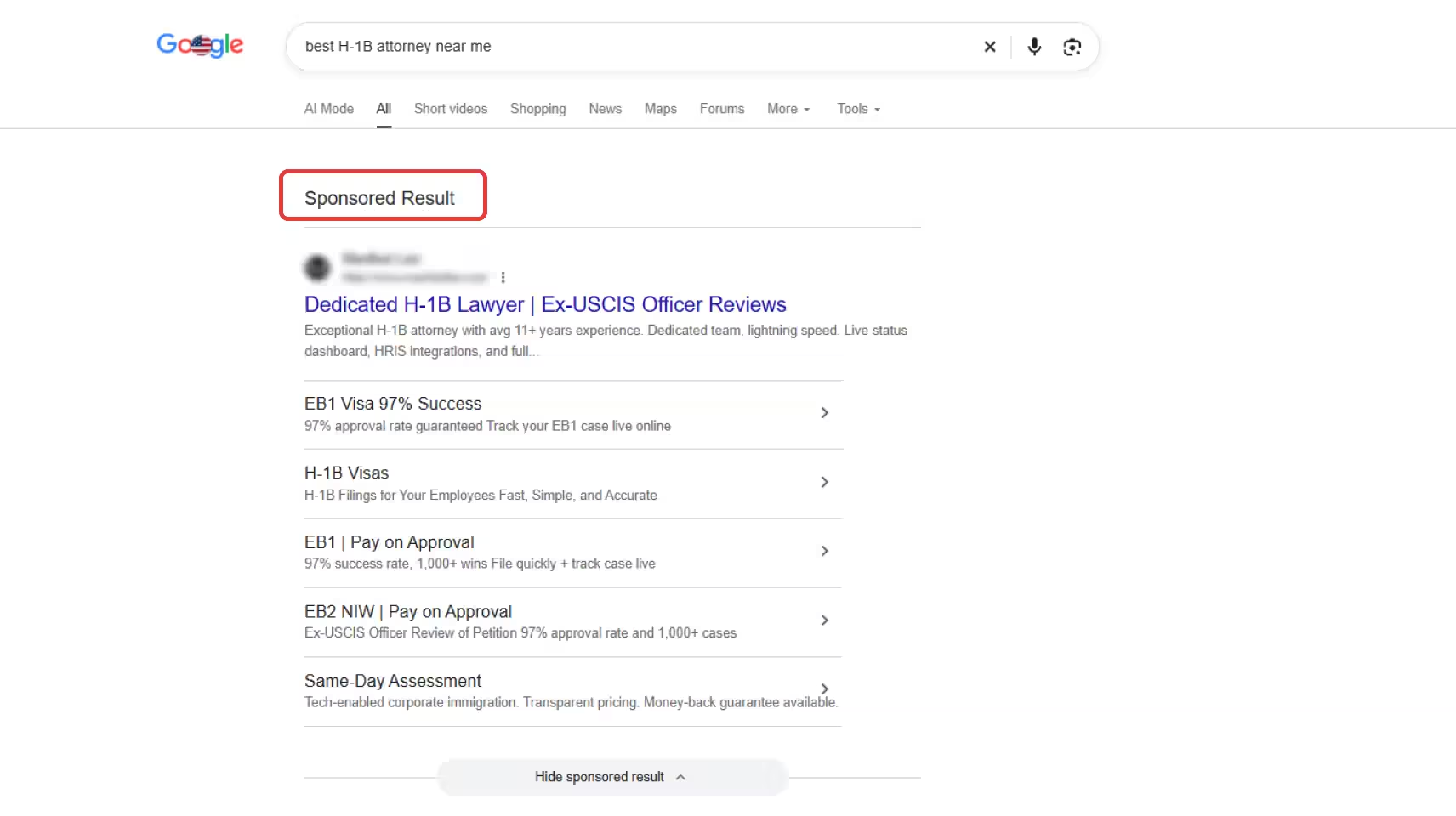
You're not waiting for Google to decide your page deserves a top spot. Here, you're bidding for that spot directly.
That's different from SEO, which builds organic visibility over time (typically 6-12 months). Google Ads for immigration lawyers gets you visible faster, but “faster” isn't the same as guaranteed results.
A click just brings someone to your landing page. What happens next is on you, and it decides whether the click was worth the money. Explore our immigration law firm website examples for ideas on presenting services and building trust.
The real question isn't "Does PPC work for immigration lawyers?" It's whether PPC works for your firm, specifically. That depends on a few things:
- The offer. Are you promoting a free consultation, a flat-fee filing service, or a full-scope representation? The ad and landing page need to match what you're offering.
- The language. If your ad runs in Spanish, Mandarin, or Haitian Creole, your landing page and intake staff need to carry that through. A click from a Spanish ad that lands on an English-only page and an English-only phone line is wasted.
- The geography. Immigration cases aren't bound to your office's state the way a personal injury case is. They are bound by where you're authorized to practice and where you can realistically take on a client.
- The intake capacity. A qualified lead that sits in a voicemail for three days is a wasted lead. PPC only pays off if your intake process can move as fast as your ads do.
Are you confident you can get those four things right? Then those clicks have a real shot at becoming an inquiry, then a qualified lead, then a consultation, and eventually a retained client.
Otherwise, you're just paying Google to send you traffic that hits the “Back” button.
How Much Does Immigration Lawyer PPC Cost?
There's no single "immigration PPC cost" across the board.
Immigration lawyer PPC costs shift by market, competition, and case type. We recommend starting from a real benchmark and building your own numbers from there.
The benchmark. According to WordStream and LocaliQ's 2026 Google Ads benchmark report, which analyzed more than 13,000 Google and Microsoft search campaigns between April 2025 and March 2026, “Attorneys & Legal Services” landed here:
| Metric | Attorneys & Legal Services (2026) |
|---|---|
| Cost per click (CPC) | $9.87 |
| Conversion rate | 5.55% |
| Cost per lead (CPL) | $131.63 |
P.S. This spans the entire legal category (from personal injury to family law to immigration). Treat it as a reference point. Your actual immigration lawyer PPC costs will move based on your market, your keywords, and how tightly your campaigns are targeted. Remember:
Spend versus fees. Your PPC budget and your management fees are two different line items.
The ad spend goes directly to Google (or Microsoft) for clicks. If you work with an agency or manage campaigns in-house, that's a separate cost on top of spend. Keep these separate when you calculate what Google Ads for immigration lawyers is costing you.
Daily and monthly limits. Google Ads campaigns are typically set with an average daily budget. No hard daily caps.
This means most unchanged campaigns can spend up to twice their average daily budget on any given day, with a monthly ceiling of about 30.4 times the daily average. Budget accordingly.
A campaign that looks like it "overspent" on a given day may simply be within Google's normal delivery pattern.
The metrics to watch. Click volume and cost per click tell you what you're paying Google. They don't tell you whether immigration lawyer advertising is working for your firm. These four numbers do:
- Qualified cost per lead (CPL) = media spend ÷ qualified leads
- Media client acquisition cost (CAC) = media spend ÷ signed clients
- Total marketing CAC = all relevant marketing costs ÷ signed clients
- Return on ad spend (ROAS) = attributable collected firm revenue ÷ ad spend
- Marketing ROI = (attributable contribution before marketing costs − total marketing costs) ÷ total marketing costs × 100%, where contribution is attributable collected fees minus your legal service-delivery costs
How to plan a budget:
- Start from your click-to-inquiry rate: what share of clicks turn into a form fill or call.
- Apply your inquiry-to-qualified-lead rate: what share of those inquiries are accepted case types.
- Apply your qualified-lead-to-signed-client rate: what share of qualified leads you retain.
- Work backward from a signed-client target through those three rates to a rough spend estimate.
- Label anything you haven't measured yet as a forecast, not a result, and revisit it once you have real campaign data. Don't blend forecasted numbers with measured ones in the same cohort.
How to Build an Immigration PPC Strategy (9 Steps)
You’ve seen what immigration lawyer PPC is. You’ve seen the immigration lawyer PPC cost benchmarks. Now, let’s talk about how to run Google Ads for immigration lawyers.
The 9 steps below build in order: case fit first, then targeting, then the landing page and tracking that make the traffic worth paying for.
Platform mechanics that apply to any law firm (account structure, bidding basics, campaign types) are covered in more depth in our Google Ads setup guide for law firms.
This section focuses on immigration only.
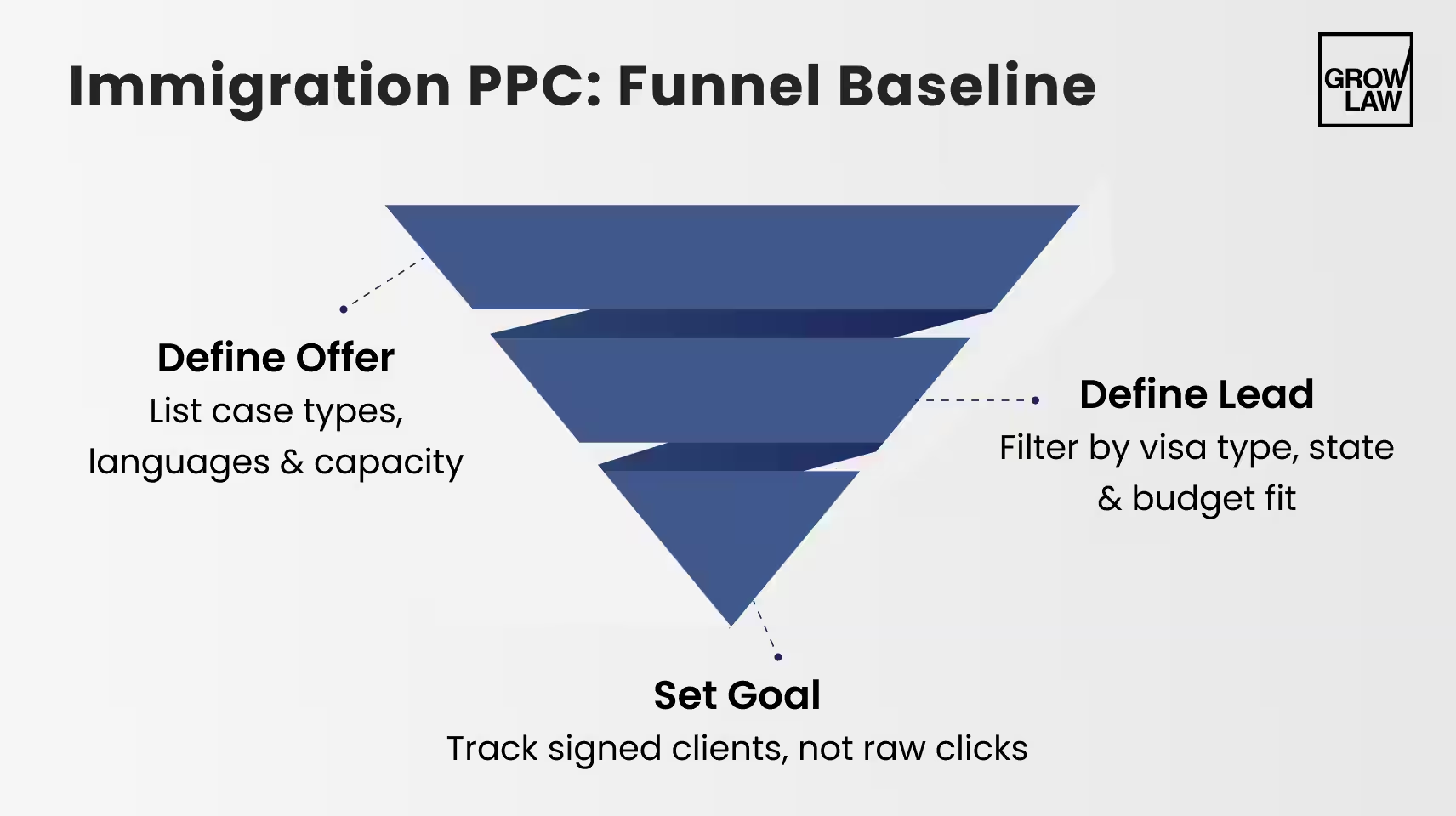
1. Define the offer, qualified lead, and retained-client goal
Before you write a single immigration lawyer PPC ad, write down what you're selling.
That may sound odd, but trust us, it's necessary in your PPC strategy for immigration lawyers. Pen down:
- Case types you accept (e.g., family-based, employment, asylum, removal defense)
- Jurisdictions or forums you serve (e.g., immigration court, specific federal circuits)
- Languages your team works in (e.g., Spanish, Mandarin, Haitian Creole)
- Consultation terms (e.g., free 15-minute intake call)
- New-case capacity (e.g., 9 new cases this month)
Then, decide what counts as a “qualified lead” for your firm.
For example, a qualified lead might be someone with a pending H-1B renewal who lives in a state you serve and can pay your consultation fee.
A qualified lead is not just anyone who fills out a form asking general visa questions. See the difference? Treating every inquiry as equally valuable is a mistake.
Lastly, set a retained-client goal: how many of those qualified leads you expect to sign as clients each month (e.g., 5 of your 9 open case slots). That number is what your immigration lawyer advertising spend should ultimately be judged against.
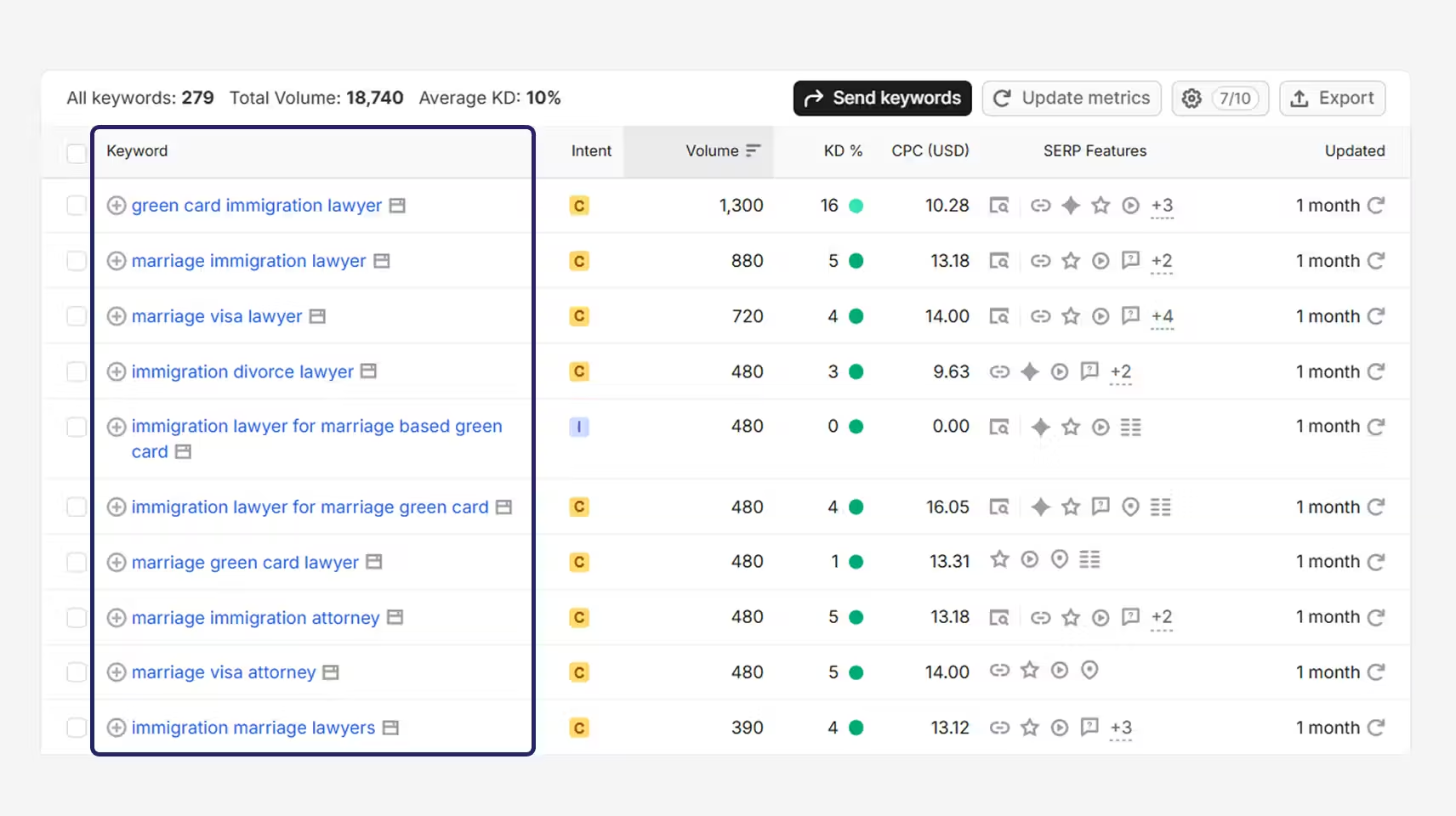
2. Group keywords by case type and intent
Once you know which cases you're trying to fill, your immigration attorney advertising keywords should follow the same logic.
Structure your campaigns around the case types you take on. Don’t use one catch-all "immigration lawyer" ad group; that phrase is too broad to tell Google (or your prospect) what you do.
A planning matrix to start from:
| Case Type | Example Keyword |
|---|---|
| Family immigration | marriage green card lawyer |
| Employment immigration | H-1B attorney |
| Citizenship | naturalization lawyer |
| Removal defense | deportation defense lawyer |
| Asylum | asylum attorney |
These are just examples to build from. Do not take this as a ranked list of the "best" keywords or a volume-verified recommendation for your firm.
Like we said, include only the groups tied to services you offer, and map each one to a matching service page and intake path.
If a potential client Googles "asylum attorney" and clicks your ad, send them straight to an asylum-specific page, and make sure whoever picks up the phone or answers that form understands the basics of asylum cases.
That match between search, click, landing page, and intake is what keeps the momentum you paid for.

2026 edition
How to Get More Clients for a Law Firm
3. Choose match types and review irrelevant searches
Ultimately, you want to get the right person to the right page. But that means not bringing in the wrong person. How do you do that?
Understand your match type options. Match types control how closely someone's search has to resemble your keyword before your ad shows:
| Match Type | How It Works | Example Keyword | Might Also Trigger For | Reach vs. Control |
|---|---|---|---|---|
| Broad match | Shows your ad for searches related to your keyword's meaning, even with different wording | immigration lawyer | "how to find a lawyer for a visa," "help with green card process" | Widest reach, least control |
| Phrase match | Shows your ad when the search includes your keyword's meaning in the same general order | "H-1B attorney" | "best H-1B attorney near me," "H-1B attorney cost" | Middle ground between reach and precision |
| Exact match | Shows your ad only for searches that mean the same thing as your keyword | [asylum attorney] | "asylum lawyer," "attorney for asylum" | Narrowest reach, most control |
Check what's triggering your ads. Is it the right reach? Review your search terms report weekly when a campaign is new, then move to a biweekly or monthly check once it's stable and negative keywords are caught up.
Add contextual negative keywords. Someone searching "immigration paralegal job" isn't a prospect. Exclude searches like these as you spot them.
But don't over-exclude. Avoid blanket-blocking words like "work," "application," or "free consultation" just because they show up in some irrelevant searches.
Those same words appear in real, ready-to-hire searches too, like "work visa application" or "free consultation immigration lawyer," so excluding them wholesale cuts off prospects along with the noise.
4. Set serviceable geography
You've cleaned up who sees your immigration attorney advertising. Next ask: where should they be seeing your ads?
That comes down to geography. Immigration law breaks the usual rules here.
Know what federal authorization covers. Say your office is in Chicago. Under 8 CFR 292.1, you can still represent a client filing with USCIS from Phoenix, or fighting a removal case out of a Texas immigration court. Good standing is what matters, not your office address (8 CFR 1.2 spells out that bar admission).
However, this does not mean you can advertise everywhere without limit. It doesn't cover a state-law matter, or an in-person court appearance where you're not admitted. Over your ZIP code, your authorized scope is the boundary.
Separate local consultations from wider federal practice. Do you need clients to walk into your office, or show up in person for a state court date? Keep that targeting local. Filing a green card petition or fighting a removal case before USCIS or immigration court is federal. You can reasonably target further out.
Choose between “Presence” and “Presence or interest.” Google gives you two options. “Presence” shows your ad only to people physically in your target area. “Presence or interest” also catches someone in another state (or country) who's actively searching for your area.
Let’s say you're licensed to handle cases nationwide and want to reach a family member abroad searching on behalf of someone stuck in the U.S. immigration system. “Presence or interest” gets you in front of them. If that's not your setup, stick with “Presence” and keep your spend narrower.
Don't use language as a stand-in for geography. Running a Spanish-language ad doesn't tell you where that person lives. And it definitely doesn't tell you their immigration status. Set your location targeting based on where you're authorized and equipped to serve, full stop.
5. Align languages across ads, pages and intake
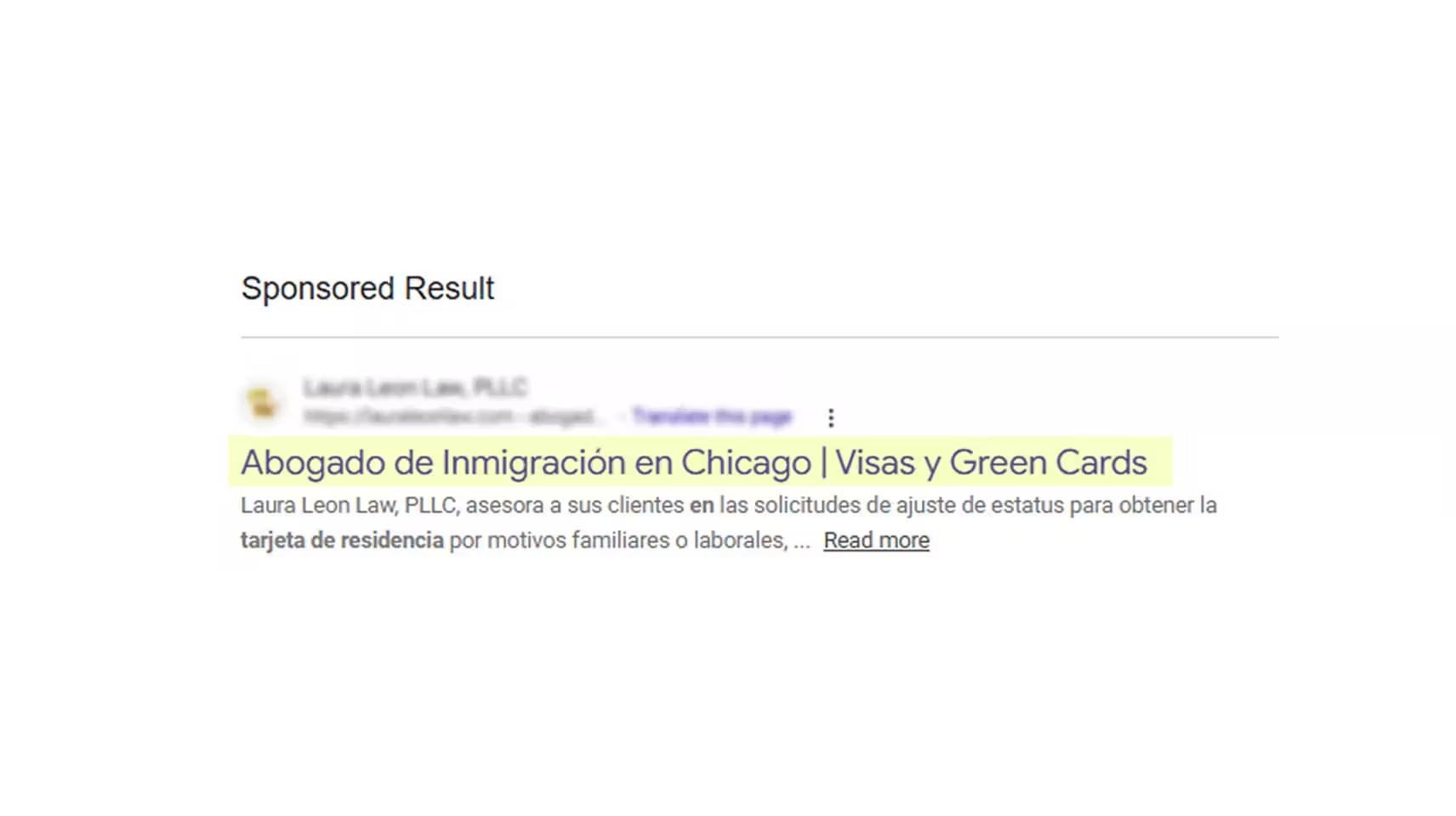
You just set boundaries on where your ads reach. The next step in how to run Google Ads for immigration lawyers is language. Run your ads in a language you can follow through on.
If you're advertising in Spanish, Mandarin, Haitian Creole, or anything beyond English, everything downstream needs to match. And we do mean everything.
A prospect who clicks a Spanish-language ad and lands on an English-only page, then gets an English-only voicemail, is a lead you paid for and lost.
One more thing worth knowing: Google has announced it is removing campaign-level language settings from Search starting September 2026, shifting toward matching based on the language of the ad copy itself.
What does this mean? You’ll be losing the manual toggle so your ad copy itself becomes the only signal for language matching. The burden shifts from checking a setting to making sure your copy is unambiguously written in the language you intend it to match.
And keep language and immigration status separate in your thinking. The language someone searches in says nothing about their legal status. Treating it as a proxy isn't just inaccurate, it's a policy risk on top of it.
Your Ads Are Begging for a Glow-Up
Put your PPC to work! Lawyers see up to 1,018% more leads with our top-ranked SEO and PPC services.
Yes, Give Me More Leads

6. Choose channels and draft campaign settings
Your language and geography settings are locked in. Now decide which medium those ads run.
Make Google Search your primary channel. It captures people actively searching for the exact service you offer, right when they need it. That “ready to hire” intent is hard to replicate anywhere else.
Consider Local Services Ads (LSAs). Most licensed immigration lawyers can run Local Services Ads, depending on availability in your area and a verification process you'll need to complete.
LSAs bill per lead instead of per click, which is a real shift in how you budget. Understand that cost model before you turn it on.
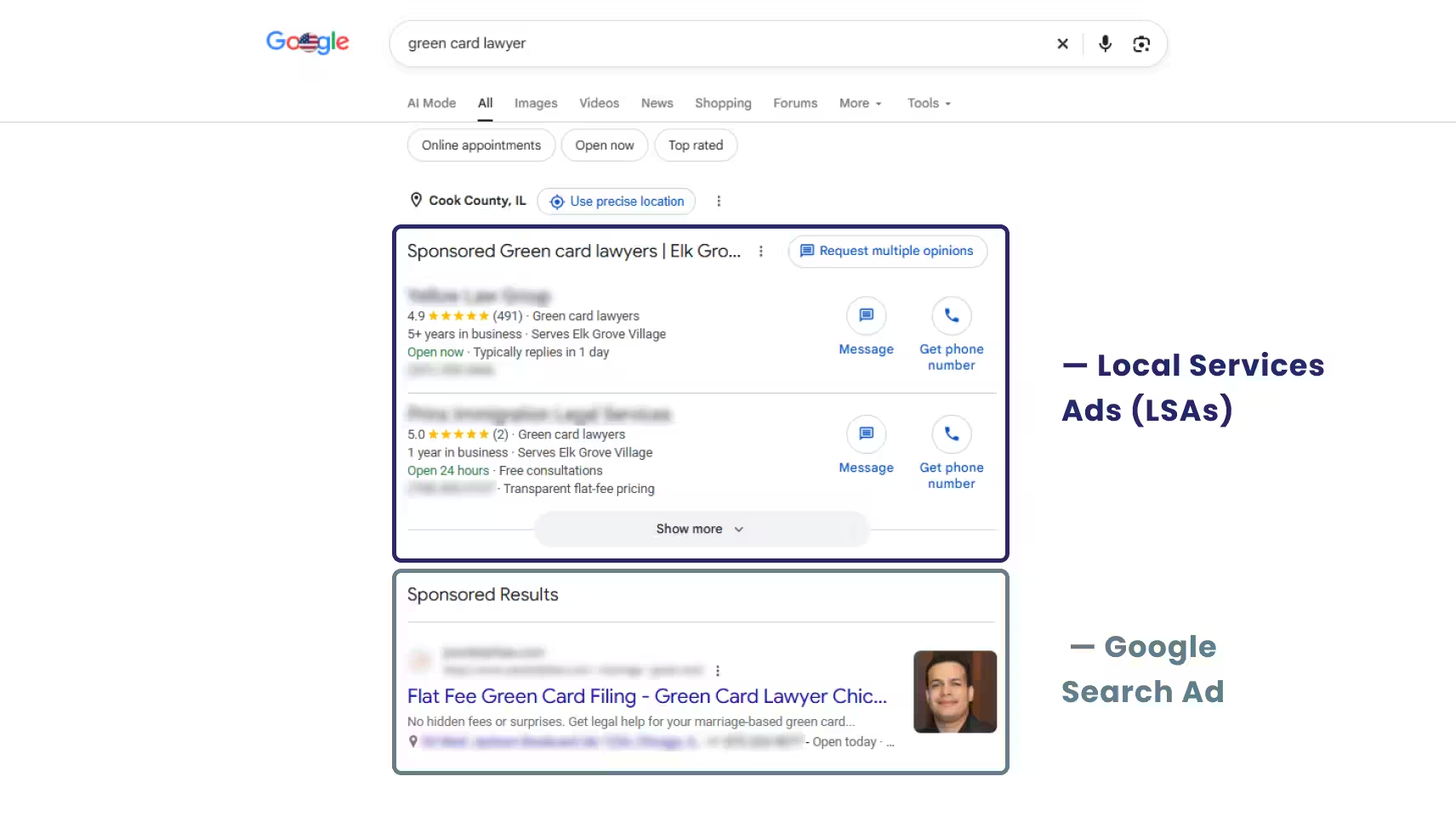
Give social and Display a supporting role. These channels can help with retargeting past visitors or building general awareness, but they shouldn't carry your campaign. Keep in mind that sensitive-service restrictions apply here too, which we'll cover in the policy section below.
Draft your settings now, but don't launch yet. You still need your landing pages and tracking in place, which is exactly what steps 7 and 8 cover next.
7. Build case-specific, language-matched landing pages
Your settings are drafted. Before you flip them on, your landing page needs to hold up its end of the bargain.
This is the moment of truth where the click (that you paid for) either converts or leaves.
Here's what to check before you launch your PPC strategy for immigration lawyers:
| Element | What to Do |
|---|---|
| Service clarity | Match the page to the exact case type in the ad (e.g., an "H-1B attorney" ad lands on an H-1B-specific page, not a general immigration page) |
| Credentials | Show attorney names, bar admissions, and relevant experience, no a generic "our team" statement |
| Consultation terms | State upfront whether it's free, how long it runs, and whether a deposit is required |
| Mobile contact | Include a tap-to-call button, rather than just a contact form |
| Initial form | Ask only for name, phone number, and a one-line description of the situation |
| Core Web Vitals | Aim for LCP under 2.5 seconds, INP under 200 milliseconds, and CLS under 0.1, measured at the 75th percentile, separately for mobile and desktop |
Curious to see what immigration attorney PPC looks like in action?
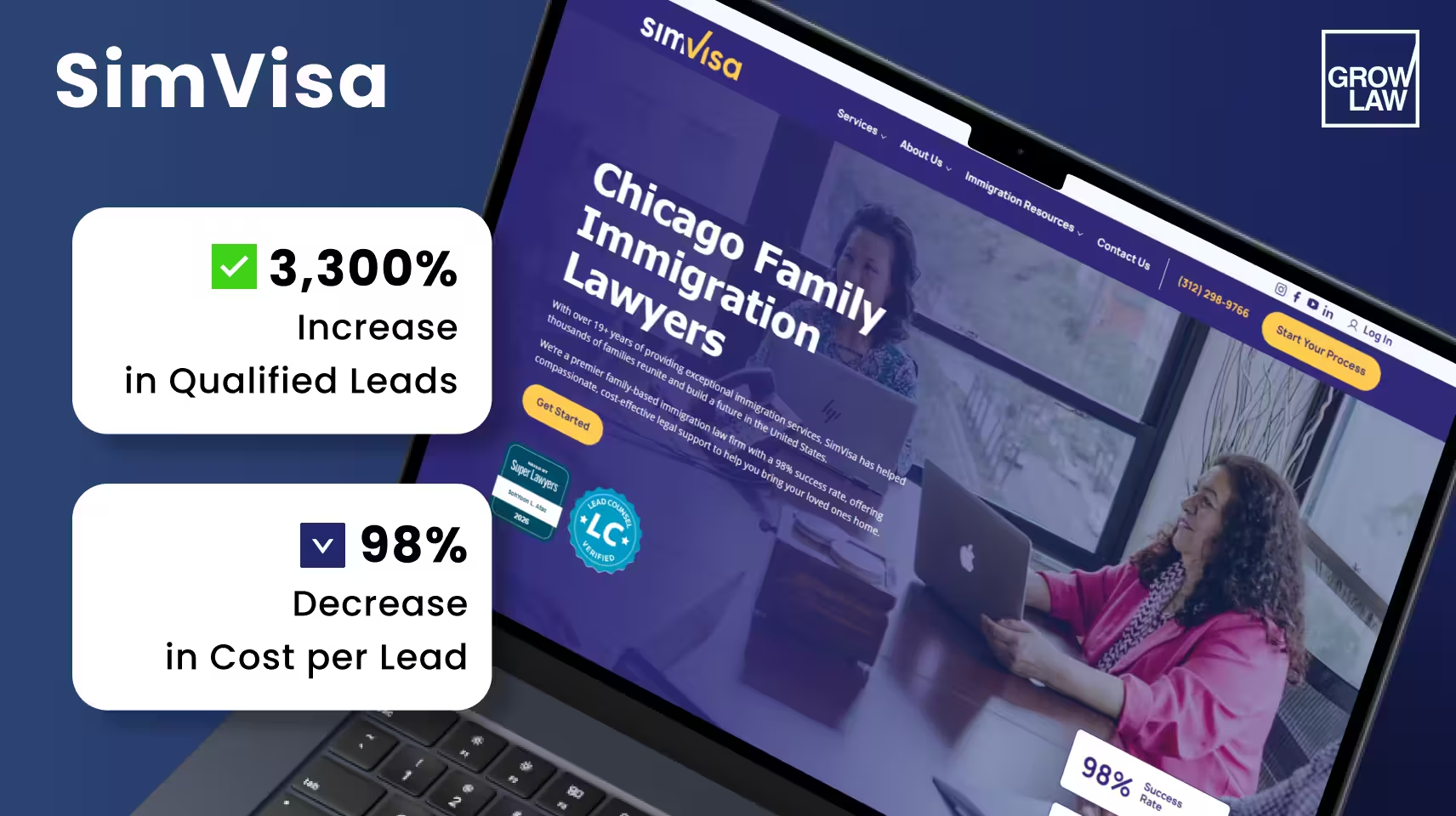
Check out SimVisa's website and search strategy, a Chicago immigration firm.
We designed clearer service paths, a redesigned user flow, and supporting content work that brought its cost per lead down 98%.
That result reflects the firm's broader website and search strategy, not PPC in isolation, but the underlying principle (matching the page to what brought the click there) applies directly here.
8. Connect calls and forms to qualified and retained outcomes
Your landing page is ready. Before you go live, make sure you can see what happens after the click. This is key in your PPC strategy for immigration lawyers.
Test your calls and forms before you go live. Confirm they're tracked, tied to the right source and campaign, and not double-counting the same lead twice.
Set up stages beyond the form submission. Track inquiry, qualified lead, consultation, and signed client separately. A form fill count tells you almost nothing on its own; knowing how many of those form fills turned into signed clients tells you everything.
Use offline conversion imports where your platform allows it. Feeding signed-client outcomes back into your ad platform lets your campaigns optimize toward the outcome that matters.
Handle sensitive data carefully. Keep immigration status, case narratives, and identity documents out of any audience uploads. Apply the same consent and data-handling rules you'd use anywhere else client information touches a third-party platform.
This is where you can turn to professional PPC management. Grow Law's process uses client-owned ad accounts, direct platform billing, and qualification reporting that follows a click all the way through to a signed matter.
Once tracking is in place and verified, you're ready to launch and start optimizing, which is exactly what step 9 covers.
9. Launch and optimize for accepted matters
Tracking's in place and verified. Now let’s flip the switch.
Launch once your checks pass. If your landing pages and tracking from steps 7 and 8 aren't fully ready, hold off. A campaign that launches on schedule but without working tracking is worse than one that launches a week late with tracking intact.
Review the full picture. Once live, regularly check your search terms, case-type performance, language and location results, landing pages, and how leads move through intake. Any one of these can quietly break while the others look fine.
Use Quality Score and click cost as diagnostics. They tell you where something might be off, not whether the campaign is working. Qualified CPL and signed-client CAC are the numbers that actually answer that question.
Give it time before you judge results. There's a natural lag between a signed matter and collected revenue, and sometimes between a qualified lead and a signed matter too. Pull the plug before that lag plays out, and a working campaign will look like a failing one.
Immigration Advertising Policies and Claims to Handle Carefully
Your campaign is live. Before you scale it up, run it against a few policy checks that are specific to immigration advertising.
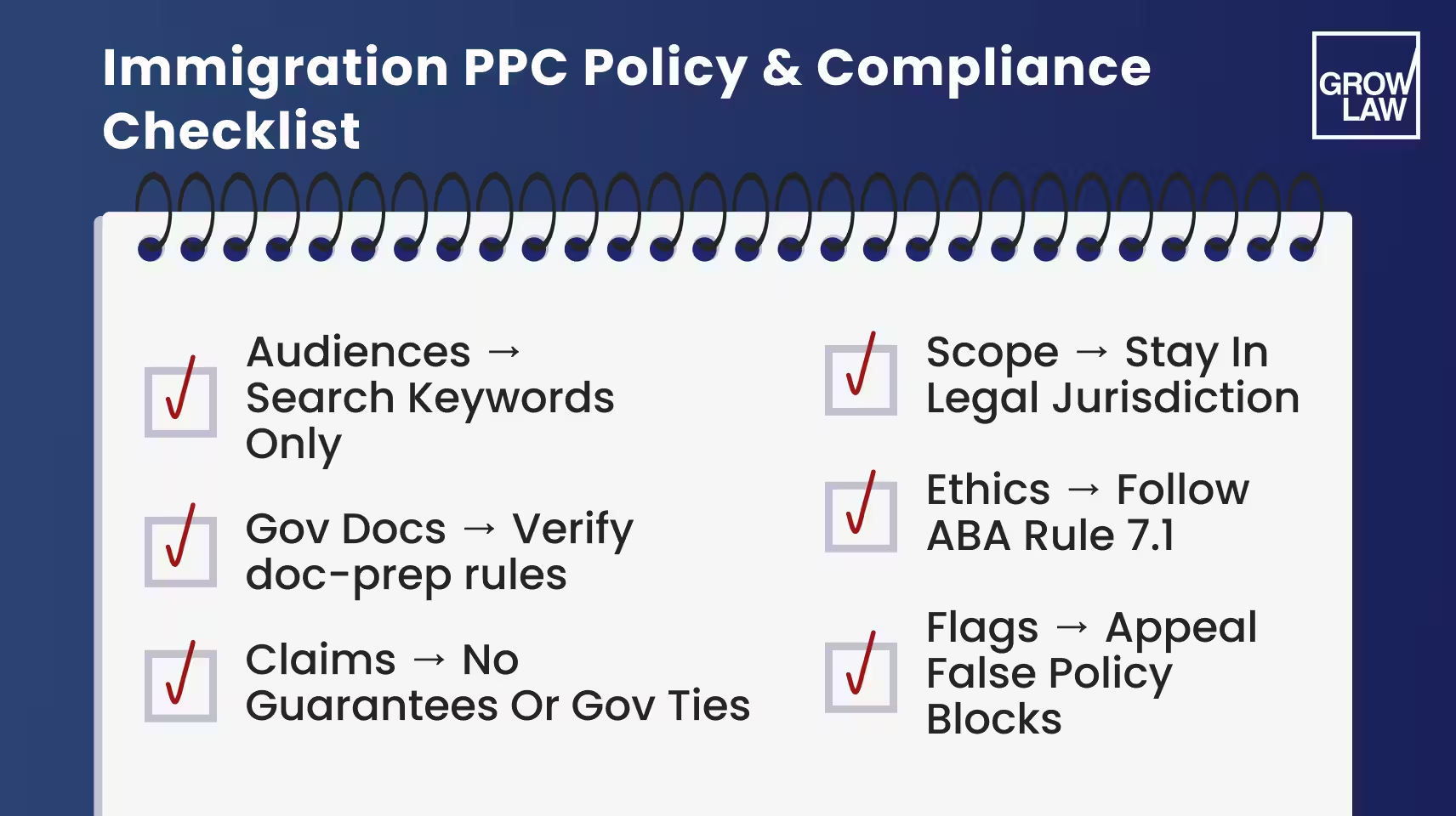
- Sensitive-service audience restrictions. Google classifies services for immigrants (including legal services for refugees and asylum seekers) as a sensitive category.
- Advertiser-curated audience targeting (custom audience lists, certain remarketing setups) is restricted for these services.
- Standard contextual Search targeting, based on the keyword someone searched, is a separate matter and isn't subject to the same restriction.
- Know which kind of targeting you're actually using before you assume a restriction does or doesn't apply.
- Government-document acquisition rules. Ads that could be read as helping someone acquire government documents fall under their own certification requirements and exclusions.
Does your ad touch on filing assistance or document preparation? Check it against this policy specifically, and don't assume every immigration-related ad automatically qualifies for an exemption. - No implied government affiliation or guaranteed outcomes. Don't let ad copy suggest a connection to a government agency, and don't promise or imply a guaranteed approval. This applies to landing pages and consultation messaging too, not just the ad itself.
- Authorized service scope. Advertise only the services you're actually authorized to provide. Under 8 CFR 292.1, that scope is broader than your office's state, but it isn't unlimited, and 8 CFR 1.2 sets the bar-admission standard that has to be met in the first place.
- Truthful, verifiable claims. ABA Model Rule 7.1 requires that communications about a lawyer's services not be false or misleading. Treat that as your floor for any claim in an ad, landing page, or consultation offer, keeping in mind that state-specific rules may add further requirements.
- If your ad gets misclassified. If Google flags an ad under a policy that doesn't actually apply to it, use the platform's appeal or exclusion request process rather than rewriting the ad to avoid the classifier. A wrongly flagged ad is a fixable review issue.
None of this means immigration advertising is off-limits or unusually risky to run.
It means a few extra checks belong in your process, the same way geography and language checks do. That way, your campaigns stay compliant.
Put Your Immigration PPC Plan into Practice
You've got the framework: case fit first, then language and geography, then a landing page and tracking setup that connects a click to a signed client. Our immigration law firm marketing guide covers the wider strategy beyond paid search.
But here’s the catch: Running PPC well, week after week, is a different job than building it out.
Turn to professional PPC management. Grow Law's process keeps your ad accounts in your name with direct platform billing, reviews your campaigns weekly, builds the case-specific landing pages this guide walks through, and reports on qualification and retention in our live Growth Portal.
That said, immigration attorney PPC is one piece of a bigger acquisition strategy. If you're looking for support beyond paid ads, from SEO to content to intake, head to our immigration law marketing support page.
Frequently Asked Questions
Got questions about immigration PPC? We answer them below. If you don't see your question, contact us directly.
-
What is PPC for immigration lawyers?
With immigration law PPC, you pay each time someone clicks your ad, and in return, you place your firm in front of the right people searching for immigration legal help. It's a paid placement model, not organic ranking, and you cover the cost per click rather than a flat rate.
-
How does immigration lawyer PPC work?
You bid on a relevant search, someone clicks your ad, and you send them to a landing page matched to that case type and language. From there, you measure whether that click turns into an inquiry and a qualified lead. If you're running Local Services Ads instead of standard Search ads, you pay per lead rather than per click, so keep those two billing models separate in your head.
-
Are Google Ads worth it for immigration lawyers?
You need to check a few things first. Does the search match a service you actually offer? Do you have the capacity to take on the case? And once you factor in what it costs you to acquire that client against what they contribute to your firm, does the math work? If those line up, PPC can work well for you. If they don't, more traffic just means more cost.
-
How much does immigration lawyer PPC cost?
You'll pay for clicks, and separately, you may pay management fees if you work with an agency. As a broad reference point, WordStream and LocaliQ's 2026 benchmark puts the Attorneys & Legal Services category at $9.87 per click and $131.63 per lead, but that spans the entire legal industry, not immigration specifically. Your real costs will depend on your market and competition.
-
What are the best PPC keywords for immigration lawyers?
There's no universal "best" list you can copy. Start by mapping your actual case types to matching search intent, like "H-1B attorney" for employment immigration or "naturalization lawyer" for citizenship cases. Build from the case types you accept, rather than working from someone else's keyword list.
-
How much should an immigration law firm spend on Google Ads?
Start with how many retained matters you want each month, then work backward through your click-to-inquiry, inquiry-to-qualified-lead, and qualified-lead-to-signed-client rates to estimate your spend. If you don't have that data yet, label your numbers as a forecast, and update your budget once you have real-world campaign results to work from.
-
How can immigration lawyers reduce PPC costs?
Go beyond price. Focus on relevance. Tighten your negative keywords, make sure your ad language matches your landing page and intake staff, and qualify leads consistently so you're not paying to chase people who were never going to sign. Chasing the cheapest clicks alone usually brings you more of the wrong traffic.
-
How do immigration law firms measure PPC ROI?
You measure it by comparing your attributable revenue against your total marketing costs, not just your ad spend, and by using consistent client cohorts so you're not comparing this month's leads to last year's results. Keep ROAS (revenue against ad spend) and client acquisition cost separate, since they answer different questions about your campaign.

Compare Your Practice Instantly
Stay Ahead of the Competition!
Compare your law firm's performance to Local competitors with our instant assessment tool
Get a clear picture of your firm's performance
Boost your online presence
Compare My Firm
Compare Your Practice Instantly
Stay Ahead of the Competition!
Compare your law firm's performance to Local competitors with our instant assessment tool
Get a clear picture of your firm's performance
Boost your online presence
Compare My Firm
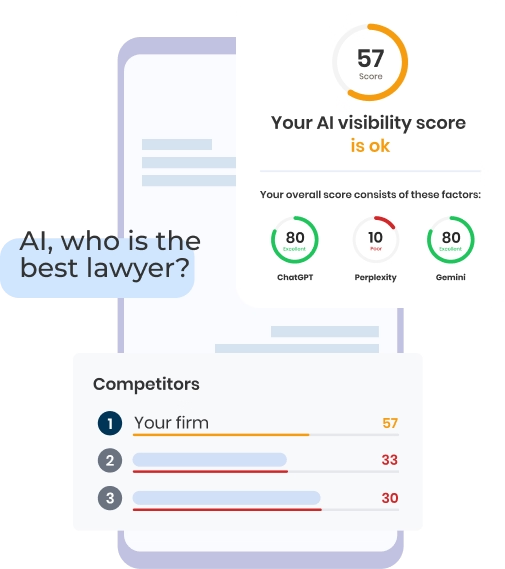
Check Your AI Visibility Instantly
Find Out What AI Is Telling Your Potential Clients
Run our free AI Visibility Report to:
See how often top AI tools mention your law firm
Spot which competitors show up first
Get the next steps to capture more cases
Run My Free AI Report